
Wedding guest guide
What you will see, what to wear and how to behave.
At a glance
- When to arriveCheck the invitation, and arrive a little before the start.
- What to wearBright, happy colours are welcome. Many families prefer guests not to wear all black or all white, as white is often worn for mourning. Covered shoulders are respectful. Indian clothes are welcome, never required.
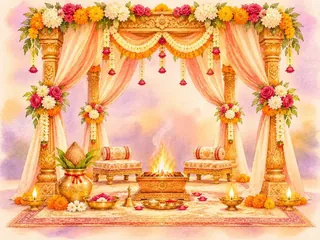
- ShoesShoes come off before the mandap (wedding canopy). In the seating area, follow the family. Slip-on shoes help.
- Photos and foodPhotos are usually welcome. Stay in your seat and out of the aisle. There is usually a meal after, often vegetarian. No alcohol during the ceremony.
You do not need to know Sanskrit. Pandit Ji explains each step in English.
Planning your own wedding? Read about weddings
What you will see
Seventeen steps in five parts. Tap a part to read what happens and what it means. Every family’s order can differ a little, and Pandit Ji explains each step on the day.
The welcomeSteps 1 to 4: Vara Aagman, Madhuparka, Ganesh Puja, Kanya Aagman
- 1Vara Aagman: the groom arrivesThe groom comes with his family and friends, and the bride’s family welcome him. The bride’s mother greets him with a welcome ritual and leads him to the mandap (wedding canopy).
- 2Madhuparka: honey and yoghurt for the groomThe bride’s parents offer the groom honey and yoghurt. Honey stands for sweetness, and yoghurt for strength.
- 3Ganesh Puja: prayer to Lord GaneshA prayer to Lord Ganesh, who removes obstacles, to bless the couple and the day.
- 4Kanya Aagman: the bride arrivesThe bride is brought to the mandap, often by her brothers or her mama (mother’s brother). A cloth curtain, the antarpat, is held between the couple and lowered after a prayer. They see each other and exchange garlands.
The promiseSteps 5 and 6: Kanya Daan, Hastamelap
- 5Kanya Daan: giving away the brideA loop of sacred cotton thread is placed around the couple, and the bride’s parents place her hand in the groom’s hand.
- 6Hastamelap: joining of hands and tying the knotThe couple’s right hands are joined, with a betel nut between them, and covered with a red cloth. The groom’s sister ties the knot of their scarves.
Around the sacred fireSteps 7 to 10: Vivaha Havan, Shilarohana, Mangal Pheras, Saptapadi
- 7Vivaha Havan: lighting the sacred fireThe sacred fire is lit. Agni, the fire, is the eternal witness to the marriage.
- 8Shilarohana: stepping on the stoneThe bride places her foot on a stone, a sign of strength and staying firm together in difficult times.
- 9Mangal Pheras: rounds of the sacred fireWith their scarves tied, the couple walk around the fire four times, for the four aims of life: Dharma (duty), Artha (honest wealth), Kama (love) and Moksha (spiritual freedom). Some families take seven pheras, as per their own tradition.
- 10Saptapadi: the seven stepsThe couple take seven steps together, one promise with each step. After this, the bride sits on the groom’s left side.
The seven promises:
- Food and care for each other
- Strength in body and mind
- Wealth earned by right means
- Happiness and harmony together
- Children and a happy family
- Prosperity and a long life
- Loyalty and lifelong friendship
BlessingsSteps 11 to 15: Kansar Bhakshan, Chab, Akhand Saubhagyavati, Mangal Sutra and Sindoor, Ashirvaad
- 11Kansar Bhakshan: the first meal togetherThe bride’s mother brings kansar, a sweet of crushed wheat, sugar and ghee, and the couple feed it to each other.
- 12Chab: gifts for the bride from the groom’s familyThe groom’s family give gifts to the bride, a warm welcome into her new family. Each family does this in its own way.
- 13Akhand Saubhagyavati: blessings from married womenMarried women of the family whisper “Akhand Saubhagyavati” in the bride’s ear: a blessing for good fortune and a long, happy married life.
- 14Mangal Sutra and Sindoor: the sacred necklace and red powderThe groom ties the mangal sutra (sacred necklace) and puts sindoor (red powder) in the parting of the bride’s hair.
- 15Ashirvaad: first blessing as husband and wifePandit Ji and the elders bless the couple, and the couple touch the elders’ feet with respect. Guests often shower flower petals or akshat (blessed rice).
The farewellSteps 16 and 17: Koda Kodi, Vidai
- 16Koda Kodi: a playful ring gameA ring is hidden in a bowl, and the couple search for it with one hand. Everyone cheers for the winner, said to be the one who will lead at home.
- 17Vidai: farewell to the brideThe bride says goodbye to her family as she leaves with her husband. It is a happy and tearful moment.